
Quick Answer
Sourcing from China in 2026 remains highly cost-effective but requires navigating three new threat vectors that did not exist two years ago: AI-generated factory fraud, ESG compliance mandates, and cross-border payment scrutiny. Buyers can eliminate over 95% of procurement risks by defining technical product specifications, verifying factories through government databases and live video, enforcing strict AQL inspection standards, and maintaining 100% financial transparency.
1. Introduction: Why 2026 Is Different — and More Dangerous — Than Any Previous Year
Sourcing products from China can feel risky and complicated. You worry about scams. Poor quality. Losing money. But with a clear strategy, you can protect your investment.

China remains the world’s leading manufacturing hub. Its supply chain depth and industrial clustering are unmatched. But 2026 is not 2024 with a new calendar.
Three structural shifts have rewritten the risk landscape:
1. AI-Generated Factory Fraud. Tools like Sora, Runway, and Kling now produce hyper-realistic factory tour videos — workers, production lines, warehouse shots — all fabricated from a simple text prompt [1]. A supplier who sends you a "factory video" in 2026 may not even have an office.
2. Mandatory ESG Customs Barriers. The European Union’s Corporate Sustainability Due Diligence Directive (CSDDD) and the United States’ Uyghur Forced Labor Prevention Act (UFLPA) have shifted from early regulatory warnings to aggressive, algorithmic enforcement [2]. Importers must prove full traceability — raw material provenance, environmental waste permits, and labor audit trails — or face immediate cargo seizure and crushing fines at the port of entry.
3. Cross-Border Payment Scrutiny. Compliance banks have aggressively tightened Anti-Money Laundering (AML) and Know Your Customer (KYC) requirements on China-bound wires. Sending money to unverified suppliers, personal accounts, or offshore shell accounts will trigger compliance freezes, locking up your working capital for months.
Real-World Sourcing Axiom: A sub-market quote is a financial trap. A factory squeezed to zero margins will inevitably claw its profit back through unauthorized material swaps, compromised structural packaging, or forged compliance certificates. True cost reduction is achieved through zero-defect rates and frictionless customs clearance, never through the cheapest upfront quote.
2. The REPA "RANG" Sourcing Strategy
To safely navigate this high-stakes ecosystem, REPA Sourcing operates under a modernized, institutional-grade procurement framework engineered to protect international brands:
- Reliable Partner: Serving as your physical, unyielding extension on the ground in China, completely immune to digital or AI-driven deception.
- Accessible Market: Guaranteeing flawless target-market access by auditing factory environmental/labor compliance and securing auditable material provenance records before cargo dispatch.
- Navigate Complexity: De-risking local supplier negotiations, commercial contract enforcement, technical spec alignment, and complex supply chain logistics traps.
- Global Services: Delivering high-fidelity, end-to-end procurement infrastructure under our core operational philosophy: "Do what’s right."
3. The 6-Step Safe Sourcing Protocol
Step 1: Architect Rigorous Technical Product Specifications
Never initiate supplier contact with generic photographs, rough descriptions, or a simple Amazon link. This practice invites cost-cutting material substitutions and critical quality drift. You must compile an exhaustive Product Specification Sheet before engaging the market:
- Material Science: Specify exact material grades, chemical composition limits, and mechanical properties (e.g., 304 Stainless Steel vs. cheap 201 grade; specific tensile strengths; exact plastic durometer scales).
- Dimensional Tolerances: Define precise physical boundaries with acceptable engineering variances (e.g., $\pm 0.05 ext{mm}$).
- Structural Packaging Engineering: Mandate export-grade corrugated shipping cartons (e.g., 5-layer or 7-layer double-wall Kraft cardboard) and explicitly state mandatory carton drop-test standards (ISTA 1A/2A) to survive high-humidity maritime transit.
- Regulatory Compliance: Explicitly list target-market technical mandates (CE, RoHS, FDA, FCC) alongside mandatory 2026 ESG tracking data requirements (certified origin chains, local environmental permits, and audited labor declarations).
Step 2: Filter Through the Strategic Sourcing Funnel
Sifting the top 1% of manufacturers out of thousands of trading companies requires a cold, systematic filtering process. Cast a wide initial net, layer your security protocols, and aggressively narrow the field to 2–3 validated finalists.

| Channel | Best For | Trade-off |
|---|---|---|
| Online B2B Platforms | Speed, price comparison, broad search | Heavy presence of disguised trading companies |
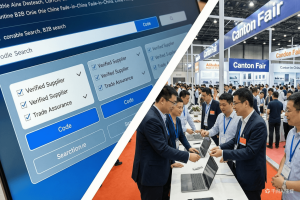
| Trade Shows (e.g., Canton Fair) | Hands-on product evaluation, face-to-face rapport | High travel cost; only curated samples on display |
| Local Sourcing Agent | On-site audits, real-time QC, crisis management | Requires transparent fee/commission structure |
- Verify Core Focus: Eliminate trading shells posing as factories. If an entity’s catalog claims they manufacture completely unrelated categories (e.g., offering both LED circuit boards and wooden outdoor furniture), they are a trading middleman. Real factories focus on specific material disciplines and production lines.
- Side-by-Side Sample Evaluation: Request physical production samples from your top 3 candidates. Do not review them in isolation. Compare finish quality, material weight, structural integrity, and functional thresholds side-by-side.
- Red Flag Behavioral Analysis: If a supplier resists direct communication channels, refuses to answer specific technical component questions, or provides generic answers, drop them immediately.
Step 3: Execute the Tri-Layer Sourcing Due Diligence Protocol
Never bypass formal legal and physical verification. Implement this definitive three-tier verification protocol before routing any corporate funds:
Tier 1: The Official Chinese Government Database Audit
Do not trust an Alibaba "Gold Supplier" badge or a PDF business license sent via email. Request the supplier’s 18-digit Unified Social Credit Code (统一社会信用代码) and audit their registration live on China’s National Enterprise Credit Information Publicity System (NECIPS) [4].
Translate the registration data and analyze the official Business Scope (经营范围):
- If the scope explicitly contains words like "Manufacture (制造)", "Processing (加工)", or "Production (生产)", they are a legally registered production facility.
- If it only states "Wholesale (批发)", "Trade (贸易)", "Sales (销售)", or "Consulting (咨询)", they are legally a middleman, regardless of what their sales reps claim.
- Check Regulatory Status: Look for indicators like "经营异常名录" (Operational Abnormality List) or "严重违法失信名单" (Serious Violations and Untrustworthy List). If these appear, freeze the relationship immediately.

⚠️ Do not rely on commercial badges like Alibaba’s "Gold Supplier" or "Verified" tags — these are marketing tools, not legal proof of manufacturing capability.
Tier 2: Tri-Document Alignment Cross-Check
Request valid ISO 9001 certifications, target-market compliance documents, and the factory’s Environmental Impact Assessment (EIA) permit. The corporate registered name must match exactly across all three of the following pillars:
| Verification Pillar | Mandatory Check Condition |
|---|---|
| 1. Business License | The foundational registered legal Chinese entity name. |
| 2. Compliance Certificates | Must match the license name exactly (verify certificate numbers on the official CNCA public registry). |
| 3. Wire Transfer Bank Account | Must match the legal corporate license name precisely. No personal or offshore shell accounts. |
Tier 3: The Live, Unscripted Factory Counter-Test
Initiate an unannounced, live video call via WeChat or commercial video channels during standard Chinese working hours. To completely neutralize 2026 AI video fraud, demand that the contact person perform three immediate, unscripted actions:
- Walk directly from the sales office to the raw material warehouse and the active production line.
- Pick up a specific random component from the line and show it up close under the lens.
- Hold a piece of paper displaying your company name and today’s current date against an active machine or the factory’s main sign.
A genuine manufacturer will accommodate this request instantly; a trading shell or fraudulent entity will manufacture technical excuses.💡 If you cannot physically visit China yourself, a local sourcing agent becomes invaluable — they conduct on-site audits and serve as your eyes and ears on the ground.
Step 4: Structure Low-Risk Price & Payment Terms
Professional procurement negotiation in 2026 centers on understanding the factory’s raw material and overhead cost structures, not crushing their viable margins.
- The Financial Leverage Standard: Enforce the strict industry standard of a 30% upfront deposit / 70% balance payment paid exclusively post-inspection. Never release the final 70% balance until an independent quality inspection has officially passed and issued a verified report.
- Escrow Safeguards: For new supplier relationships, secure your capital by utilizing trade-specific third-party escrow services or staging accounts featuring inspection-contingent release conditions.
- Formal Contracting: Lock every technical parameter, exact Minimum Order Quantity (MOQ), pricing structure, delivery timeline, and penalty clause into a comprehensive, bilingual Proforma Invoice (PI). The document must be formally stamped with the factory’s official red company chop featuring their unique 13-digit anti-counterfeiting code. Verbal promises or un-chopped digital signatures carry zero legal or commercial weight under Chinese contract law.
Step 5: Enforce Stringent Quality Control via AQL Inspections
Do not guess or assume mass production quality based on an early, hand-carried sample. Implement the international AQL 2.5 / 4.0 Standard (Acceptable Quality Limit) via a trusted on-the-ground team before the cargo leaves the factory gates.

- On-Site Operational Mandate: The quality inspector must physically execute an inventory count, perform functional stress-testing against your spec sheet, conduct carton drop-tests, and thoroughly audit raw material certificates for ESG provenance compliance.
- Rework Leverage: If the batch fails the AQL defect threshold, the factory is contractually obligated to rework the entire inventory at their own expense before receiving the final balance payment.
Step 6: Multi-Modal Compliance Logistics & Customs Clearance
In 2026, the primary point of failure in global logistics is no longer ocean freight volatility—it is regulatory non-compliance at customs.

- Traceability Matrix: Instruct your Freight Forwarder to maintain a fully transparent, auditable paper trail mapping your supply chain from raw material extraction to finished goods.
- Customs Enforcement Directives: Customs officials now demand a verifiable Traceability Matrix mapping every node of your supply chain… or your cargo will face immediate seizure [3]. Customs officials under the US UFLPA and EU CSDDD will instantly seize cargo, impose heavy administrative fines, or order forfeiture if there are any gaps in material provenance tracking, environmental waste permits, or labor condition logs.
- Maritime Risk Mitigation: Ongoing Red Sea maritime routing disruptions add roughly 10–14 days and up to 120% in excess spot freight costs to Europe and the US East Coast [5]. Mandate comprehensive cargo insurance prior to dispatch to insulate your business from transit losses or severe Red Sea routing delays.
4. The Sourcing Agent Fee Structure & Anti-Corruption Guardrails
If you lack local language fluency, structural negotiation expertise, or the ability to deploy staff to the factory floor, partnering with a local sourcing agency is highly effective. However, you must insulate your business from corrupt fee structures.
Sourcing Agency Fee Models
| Fee Structure | Operational Mechanics | Strategic Best Use Case |
|---|---|---|
| Percentage-Based Commission | Charges a transparent 5% to 10% service fee based strictly on the final FOB order value. | Ideal for SMBs and scaling brands; aligns the agent’s motivation with your order’s scaling success. |
| Flat-Fee / Per-Service | Fixed, menu-style pricing per discrete project task (e.g., $300 for a structural audit). | Perfect for experienced importers who require on-demand local "eyes and ears". |
| Project-Based Retainer | A fixed monthly retainer dedicating an exclusive, full-time local buyer team to your brand. | Engineered for enterprise organizations managing high-volume, multi-SKU portfolios. |
The Hidden Trap: Non-Transparent Kickbacks
Many traditional sourcing agents charge deceptively low or "free" upfront service fees. They then extract massive, secret kickbacks (backhand commissions) from the factory behind your back.

This double-dipping model creates a toxic conflict of interest: the agent will aggressively protect a subpar, unreliable factory that pays secret cash over an elite factory aligned with your quality goals. Learn how to spot this and five other hidden revenue traps in our guide: Sourcing Agent China Cost: Full Breakdown (2026 Guide).
The REPA Anti-Corruption Standard
To eliminate this risk and protect your margins, REPA Sourcing operates on a foundation of 100% Radical Transparency:
- Contractual Zero-Tolerance: Our service agreements dictate that receiving any factory rebates or gifts results in immediate termination and severe financial penalties.
- Open-Book Auditing: We provide clients with full access to verify all payment record related to each order.
- Pure Fee Alignment: We earn exclusively our agreed-upon, clean service fee. 100% of the true negotiation power, cost visibility, and pricing control is returned directly to the importer.
5. Supplier Vetting Checklist: Your 10-Point Due Diligence Framework
Use this definitive checklist before routing capital to any new China-based supplier. A "No" on any item marked [Critical] constitutes an automatic disqualification of the vendor.
| # | Check Item | Classification | Compliant Passing Standard (Pass) | Defective Red Flag (Fail) |
|---|---|---|---|---|
| 1 | NECIPS Scope Verification [Critical] | Legal & Structural | Business Scope explicitly lists "Manufacture", "Processing", or "Production". | Scope only lists "Sales", "Wholesale", or "Trade" (indicates trading shell/broker). |
| 2 | Corporate Name Consistency [Critical] | Fraud Prevention | Registered legal Chinese name matches letter-for-letter across Business License, Certifications, and Bank Account. | Name variations exist. Bank account belongs to an offshore shell or an individual. |
| 3 | Entity Longevity [Critical] | Risk Management | Legal entity established $\ge 3$ years with an active "In Operation (在营)" status. | Recently registered shell (<1 year) or flagged on the "Operational Abnormality List". |
| 4 | Unscripted Live Video Audit [Critical] | Anti-AI Fraud | Representative completes live, interactive video walkthrough from office to active assembly line and warehouse. | Representative refuses live feed, relies on pre-recorded videos, or makes technical excuses. |
| 5 | ISO 9001 Authentication [Critical] | Quality Infrastructure | Active ISO 9001 certification verified directly against the official CNCA public database. | Certificate is expired, forged, or belongs to a different parent manufacturing company. |
| 6 | Target-Market Certifications [Critical] | Regulatory Compliance | Valid CE, FDA, RoHS, or FCC certificates issued by accredited bodies, verified via issuing registries. | Certificates are missing, non-applicable, or self-declared by the supplier without third-party lab testing. |
| 7 | ESG & EIA Documentation [High Risk] | Customs Security | Factory provides a valid Environmental Impact Assessment (EIA) permit and complete raw material provenance trails. | Total absence of waste management records or raw material source logs (high cargo seizure risk). |
| 8 | Bilingual PI & Official Chop [Critical] | Legal Enforcement | Proforma Invoice details all technical specifications and bears the factory’s official Red Company Chop (圆形公章) with visible anti-counterfeiting code. | PI in English only. Missing any mandatory clause. Signed but not chopped, or chopped with a non-official stamp (e.g., "Sales Department" stamp without anti-counterfeiting code). |
| 9 | Independent Trade References [High Risk] | Credibility Audit | At least two verifiable foreign buyers, from different countries than your own, willing to take a 5-minute phone call. References confirm on-time delivery, consistent quality, and commercial integrity. | Factories can arrange fake reference calls — a "satisfied buyer in Germany" who is actually the factory owner’s cousin in Düsseldorf. References are all from the same country as you (potential fake ring). Reference refuses phone call ("email only"). Reference cannot name specific products, order values, or shipment dates. |
| 10 | Third-Party Pre-Shipment Inspection [Critical] | Quality Assurance | Independent third-party inspector (not the factory’s employee, not the agent’s employee without disclosure) confirmed and booked before production completion. Inspector provides timestamped report with photos, defect log, and AQL pass/fail. | "The factory does its own QC" — fail. Agent proposes inspection by their in-house staff without independent auditor disclosure — fail. No inspection budget allocated — proceed at your own risk; this is the single highest-ROI investment in the entire sourcing process. |
References & Regulatory Sources
- [1] World Economic Forum. (2026). The Global Risks Report 2026. [URL: https://www.weforum.org/publications/global-risks-report-2026/]
- [2] Official Journal of the European Union. (2024/2026 Directive). Directive (EU) 2024/1760 on Corporate Sustainability Due Diligence. [URL: https://eur-lex.europa.eu/legal-content/EN/TXT/?uri=CELEX:32024L1760]
- [3] U.S. Customs and Border Protection (CBP). (2026). UFLPA Operational Guidance for Importers. [URL: https://www.cbp.gov/document/guidance/uflpa-operational-guidance-importers]
- [4] State Administration for Market Regulation (SAMR), PRC. National Enterprise Credit Information Publicity System (NECIPS). [URL: https://www.gsxt.gov.cn/index.html]
- [5] Drewry Maritime Research. (2026). World Container Index (WCI) Assessed by Drewry. [URL: https://www.drewry.co.uk/supply-chain-advisors/supply-chain-expertise/world-container-index-assessed-by-drewry]
6. Take Action: Eliminate Your Sourcing Risk Today
Are you concerned that your prospective supplier is using AI-generated factory footage, or that your supply chain is exposed to severe customs compliance risks under the new 2026 mandates? Don’t leave your capital to luck.
Contact REPA Sourcing today. Our on-the-ground team in Guangdong will execute an official NECIPS background check and a live, interactive factory audit to secure your procurement pipeline. Let us serve as your unyielding shield on the factory floor—fully transparent, highly ethical, and completely aligned with your success.