A practical workflow guide for importers, Amazon sellers, and global brands who want to cut sourcing hours by 40–60% (based on internal project data across 200+ sourcing engagements conducted between 2024 and 2026)1 without losing control.
Quick Answer
AI tools like ChatGPT, Gemini, and Claude can dramatically reduce your sourcing workload in 2026 — but only when used the right way. They excel at supplier research, RFQ drafting, contract review, and QC checklist generation. They fail at physical verification, relationship building, and material-sensory judgment. Used as an amplifier of human expertise (not a replacement), AI cuts your procurement cycle time by roughly half while improving the quality of your output in every stage.

Introduction: Why Most Sourcing Guides Are Still Ignoring AI
Walk through any trade show in 2026, and you’ll hear the same thing: sourcing from China is getting harder. Not because manufacturing quality is declining — Chinese factories are better than ever2 — but because the information workload has exploded.
You’re juggling 20 supplier RFQs, cross-referencing Alibaba profiles against government databases, drafting bilingual PIs, keeping up with tariff changes, and trying to spot the one factory that will actually deliver what they promised. The cognitive load is breaking people.
Meanwhile, millions of professionals are using ChatGPT, Gemini, and Claude every day for coding, marketing, legal work, and data analysis. But in the sourcing industry, these tools are still massively underutilized.
This guide closes that gap. It’s not about "AI will replace sourcing agents" — that’s nonsense. It’s about using AI as a force multiplier so you spend your limited human attention on what AI cannot do: building factory relationships, touching samples, and making judgment calls that affect your bottom line.
Part 1: What AI Can and Cannot Do in China Sourcing
Before diving into workflows, let’s be ruthlessly honest about boundaries. Misunderstanding AI’s limits is more dangerous than not using it at all.
What AI Excels At
| Task | AI Capability | Time Saved |
|---|---|---|
| Supplier profile analysis | Scan 50 Alibaba/1688 listings, flag red flags, rank by credibility | 3–5 hours |
| RFQ and negotiation drafting | Generate bilingual, culturally-appropriate inquiry and negotiation emails | 1–2 hours per batch |
| Contract and PI review | Extract key terms, compare against industry norms, flag unusual clauses | 2–4 hours |
| QC checklist generation | Create AQL 2.5/4.0 inspection checklists3 for any product category | 1–2 hours |
| Market and competitor research | Analyze Amazon reviews, pricing trends, and competitor sourcing signals | 4–6 hours |
| HS code classification | Identify probable HS codes and estimate duty rates | 30–60 minutes |
| Communication translation | Real-time WeChat/email translation with cultural nuance | Continuous |
What AI Cannot Do (and Never Will)
- Physical factory audits. No AI can walk a production floor, smell whether raw materials are genuine, or count inventory racks.
- Relationship building. Chinese business culture runs on guanxi. Trust is built over dinners, factory visits, and face-to-face problem-solving — not over API calls.
- Material and sensory judgment. AI cannot touch a fabric swatch, test a hinge’s resistance, or judge whether a paint finish "feels premium."
- Real-time crisis management. When a container is stuck at customs or a factory swaps materials mid-production, you need a human on the ground making calls.
- Legal accountability. AI-generated contract analysis is advisory only. It does not replace a trade lawyer.
The Golden Rule: AI tells you what to look for. Humans go and look at it. Use AI to shrink the haystack so your limited time is spent examining the right needles.
Part 2: The AI-Powered Sourcing Workflow (6 Stages)
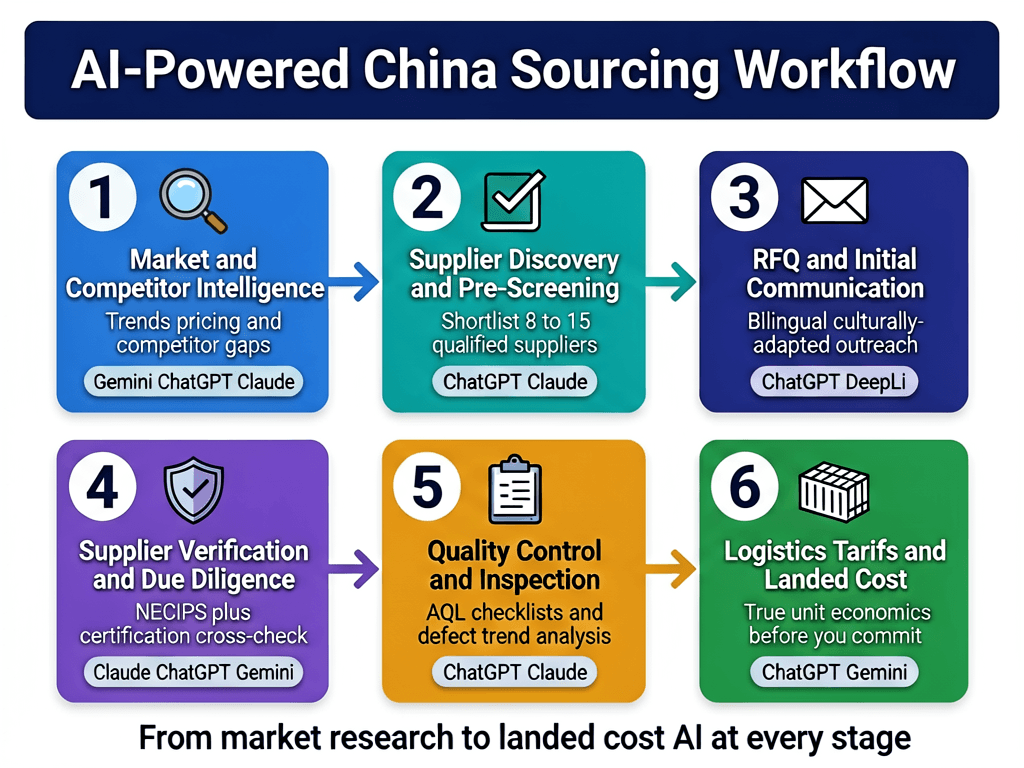
Here is a stage-by-stage integration of AI into the standard China sourcing process. Each stage includes specific prompt examples you can adapt immediately.
Stage 1: Market & Competitor Intelligence
Goal: Understand your category before contacting a single supplier.
AI Tools: Gemini (for real-time web data), ChatGPT (for structured analysis), Claude (for long-document synthesis).
What to do:
- Use Gemini to search for current market trends, tariff updates, and competitor pricing.
- Scrape Amazon/Shopify reviews with AI-assisted tools, then feed them into ChatGPT for sentiment analysis.
- Generate a "Product Opportunity Brief" summarizing demand signals, price anchors, and quality complaints in your category.
Prompt Example (ChatGPT):
I am sourcing [product category, e.g., stainless steel insulated water bottles] from China for the US market.
Analyze the following Amazon top-20 competitor review summaries and identify:

1. Top 5 recurring quality complaints customers mention
2. Top 3 features customers consistently praise
3. Price range sweet spot (where value perception is highest)
4. Packaging complaints that affect shipping damage rates

Give me a bulleted summary. Then suggest 3 product improvement opportunities that a new entrant could leverage.

[Paste review summaries here]
Output value: Before you ever talk to a supplier, you know exactly what specifications matter most and what corners your competitors are cutting.
Stage 2: Supplier Discovery & Pre-Screening
Goal: Build a qualified shortlist of 8–15 potential suppliers, not 50 random ones.
AI Tools: ChatGPT (structured analysis), Claude (document comparison).
What to do:
- Search Alibaba, Made-in-China, and 1688 for suppliers in your category.
- Export supplier profiles (company name, years in business, certifications, product range, reviews) into a spreadsheet or text block.
- Feed the list into AI with a pre-screening prompt.
- Request the top candidates’ Unified Social Credit Codes and run them through NECIPS. Feed NECIPS results back to AI for interpretation.
Prompt Example (ChatGPT):
I have a list of 20 potential suppliers for [product] on Alibaba.
Evaluate each supplier against the following criteria and rank them:

- Years in business (minimum 5 preferred)
- Whether their product range is focused or scattered (specialized is better)
- Certification claims (do they claim ISO 9001, CE, FDA, etc.?)
- Review quality (are reviews detailed and from verified buyers, or generic?)
- Red flags (claims to manufacture too many unrelated categories, registered capital too low, no factory photos showing real production)

For each supplier, give: Supplier Name → Score (1–10) → 1-sentence justification → Red flags (if any).
Then provide a ranked shortlist of the top 8.

[Paste supplier profile data here]
Output value: You go from 50 random options to 8 high-probability candidates in under 30 minutes.
Stage 3: RFQ & Initial Communication
Goal: Send professional, culturally-aware inquiries that get responses from serious factories.
AI Tools: ChatGPT (bilingual RFQ drafting), DeepL (translation quality check).
What to do:
- Draft a standardized RFQ in English using AI.
- Have AI translate it into natural-sounding Chinese (not literal translation — culturally adapted).
- Use AI to handle follow-up negotiation emails: MOQ reduction, payment term adjustment, sample requests.
Prompt Example (ChatGPT — RFQ Generation):
Draft a professional RFQ email for a Chinese manufacturer of [product].
The email should be bilingual (English first, then Chinese).

Include:
- Brief self-introduction (importer based in [country], targeting [market segment])
- Product specifications (attach or summarize key specs: material, dimensions, certifications required)
- Request for: FOB price, MOQ, production lead time, sample policy
- Tone: Professional but warm, signaling serious long-term interest
- DO NOT mention AI or ChatGPT in the email

Output format: English version → separator → 中文版本
Prompt Example (ChatGPT — MOQ Negotiation Follow-up):
I received a quote from a Chinese factory for [product]. Their MOQ is [X] units at [Y] FOB price.
I want to negotiate the MOQ down to [Z] units.

Write a polite but firm follow-up email (bilingual) that:
- Thanks them for the quote
- Explains we want to start with a smaller trial order to build trust
- Suggests we are willing to sign a 12-month framework agreement if the trial succeeds
- Asks for their best MOQ for a trial order

Maintain a collaborative, long-term-partnership tone. No aggressive bargaining language.
Output value: Consistent, professional communication across all suppliers. No more half-written emails that make you look amateurish.
Stage 4: Supplier Verification & Due Diligence
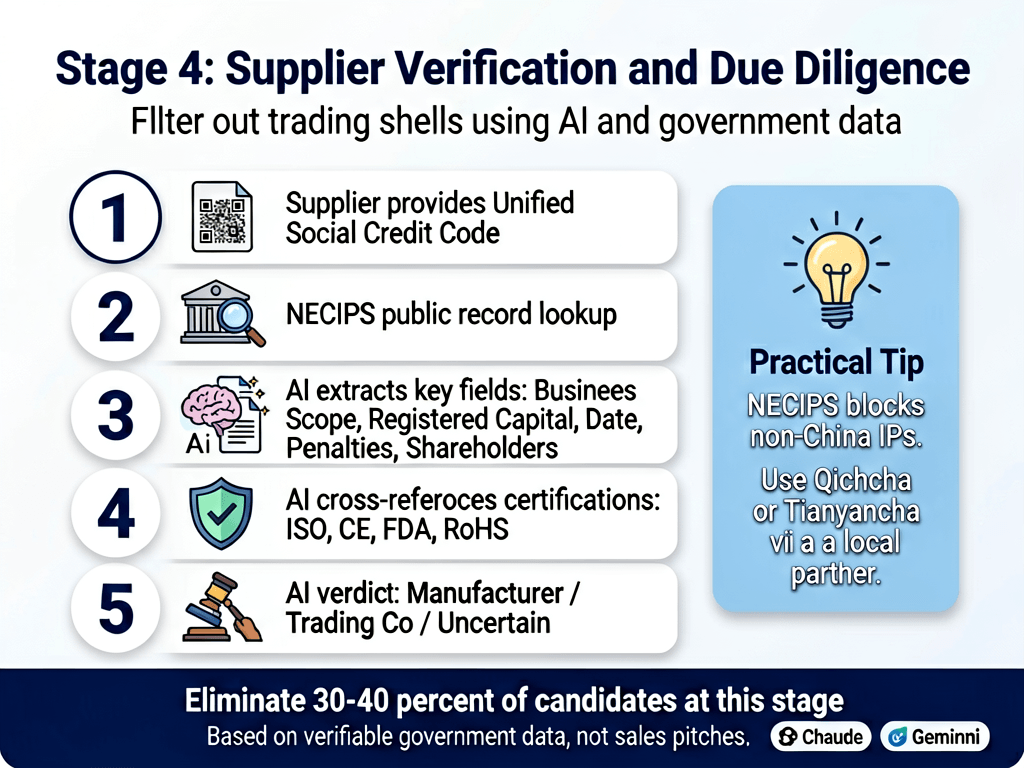
Goal: Filter out trading shells and verify manufacturing capability without flying to China for every candidate.
AI Tools: Claude (document analysis), ChatGPT (cross-referencing), Gemini (web verification).
What to do:
- Once suppliers provide their Unified Social Credit Code, look them up on NECIPS.
- Copy-paste the NECIPS result page content into AI.
- Have AI extract and interpret key fields: business scope, registered capital, establishment date, any administrative penalties.
- Cross-reference certifications: ISO, CE, FDA, RoHS. Have AI check certificate numbers against public databases when possible.
Practical Tip: The official NECIPS portal enforces aggressive CAPTCHA verification and frequently blocks non-mainland-China IP addresses. International buyers rarely succeed at directly copy-pasting from the site. A practical workaround: ask the supplier to export their official PDF credit report, or use commercial databases like Qichacha (企查查) or Tianyancha (天眼查) through a local sourcing partner who can extract the text for AI analysis.
Prompt Example (Claude — NECIPS Analysis):
Below is the NECIPS (National Enterprise Credit Information Publicity System) record for a Chinese supplier I am evaluating.

Extract and interpret the following:
1. Legal entity name (in Chinese and English)
2. Establishment date and registered capital
3. Business scope — does it include "制造" (manufacturing) or "加工" (processing)? Or only "贸易" (trading)?
4. Any administrative penalties, abnormal business status flags, or legal cases
5. Shareholder structure — any red flags (e.g., recently changed ownership, very low paid-in capital)
6. Overall verdict: Likely Manufacturer / Likely Trading Company / Uncertain

[NECIPS page content]
Output value: You eliminate 30–40% of candidates at this stage alone, based on verifiable government data, not sales pitches.
Stage 5: Quality Control & Inspection Planning
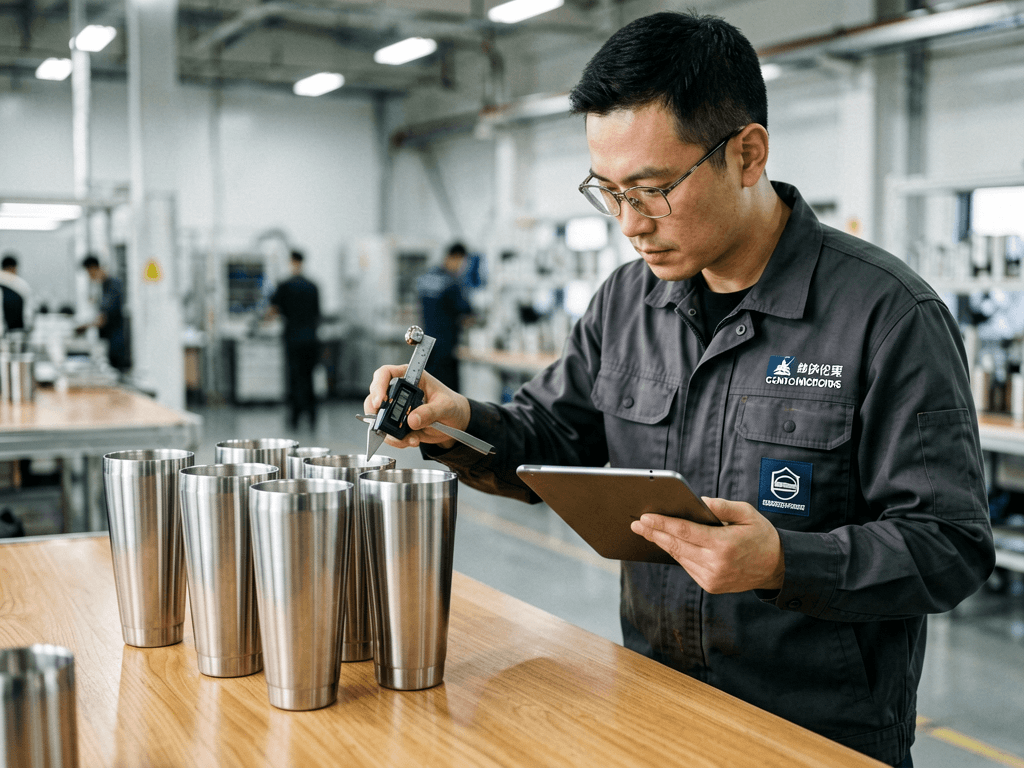
Goal: Generate product-specific inspection protocols and analyze inspection reports.
AI Tools: ChatGPT (QC checklist generation), Claude (inspection report analysis).
What to do:
- Before production starts, use AI to generate an AQL-based inspection checklist tailored to your product.
- After inspection, feed the third-party inspection report into AI for rapid analysis — flagging patterns across multiple inspections that a human might miss.
Prompt Example (ChatGPT — QC Checklist):
Generate a pre-shipment inspection checklist for [product: e.g., 304 stainless steel vacuum insulated water bottle, 500ml].

Use AQL 2.5 (Major) / 4.0 (Minor) standards. Include:

1. Visual inspection: Surface finish, dents, scratches, color consistency, logo placement accuracy
2. Dimensional check: Height, diameter, wall thickness, lid fit — with acceptable tolerances
3. Functional tests: Vacuum insulation (fill with 95°C water, measure after 6 hours — should be ≥60°C), lid seal leak test, drop test from 1m
4. Material verification: Stainless steel grade test (304 vs 201), BPA-free certification for lid components
5. Packaging: Retail box condition, barcode scannability, carton drop test, shipping mark accuracy
6. Special tests: Food-grade compliance (FDA/LFGB), dishwash durability if applicable

Format as a table with: Check Item → Method → Acceptance Criteria → AQL Classification (Major/Minor/Critical)
Output value: You hand the factory and inspector a professional, objective standard that leaves zero ambiguity about what "good quality" means.
Prompt Example (Claude — Inspection Report Analysis):
Below are inspection reports from the same factory across 3 consecutive orders for [product].

Analyze the reports and identify:
1. Recurring defect patterns (same issue across multiple orders)
2. Whether defect rates are trending up, down, or stable
3. Any discrepancies between the factory's self-inspection data and the third-party report
4. Recommendation: keep this supplier, put on probation, or replace

[Paste inspection reports]
Output value: You move from reacting to individual defects to managing supplier quality trajectories.
Stage 6: Logistics, Tariffs & Total Landed Cost
Goal: Estimate true costs and avoid customs surprises.
AI Tools: ChatGPT (HS code lookup, landed cost calculator), Gemini (tariff policy updates).
What to do:
- Use AI to identify the most probable HS code for your product.
- Build a total landed cost model factoring in FOB price, freight, insurance, tariff rate, and port handling.
- Have AI monitor and summarize relevant trade policy changes.
Prompt Example (ChatGPT):
I am importing [product description] from China to the US (Port of Los Angeles).
Please:

1. Suggest the most probable HS code(s) and the corresponding US tariff rate as of June 2026
2. Calculate estimated total landed cost per unit based on:
   - FOB unit price: $X
   - Order quantity: Y units
   - Ocean freight (FCL 20ft from Ningbo to LA): estimate
   - Marine insurance: 0.3% of CIF
   - US customs duty: based on HS code
   - Port handling and trucking to warehouse in [city]: estimate
3. Flag any anti-dumping duties, [Section 301 tariffs](https://www.congress.gov/crs-product/IF11346)[^4], or special restrictions I should be aware of

Present as a line-item table with the final landed cost per unit clearly stated.
Output value: You know your true unit economics before committing to an order. No more "surprise" costs at customs.
Part 3: AI Prompt Library — Ready-to-Use Templates
Here are battle-tested prompts you can copy, customize, and use today.
Supplier Evaluation
Analyze this supplier's Alibaba profile for credibility:

Profile: [paste]

Evaluate on:
- Years on platform vs. years in business (mismatch = red flag)
- Product category spread (too broad = likely trader)
- On-site check history
- Response rate and transaction history
- Review authenticity signals (generic language, missing details, reviewer location mismatch)
- Trade Assurance amount vs. claimed annual revenue (big gap = suspicious)

Verdict: High Credibility / Medium / Low / Avoid
Important Safety Notice: Before pasting any Proforma Invoice (PI) or contract into consumer-grade AI tools, always anonymize the data: replace actual company names with ‘Company A / Company B’, mask bank account details, and delete specific pricing figures if commercially sensitive. This protects against IP leakage risks that are particularly acute in cross-border transactions.
PI / Contract Review
Review this Proforma Invoice for a sourcing transaction.

PI content: [paste]

Check for:
1. Are payment terms clearly stated? (standard: 30/70 with balance after inspection)
2. Are specifications detailed enough to be legally enforceable? (if only a product name, flag it)
3. Is the delivery timeline realistic and does it include penalty clauses for delay?
4. Is the company name consistent with their business license?
5. Any unusual clauses that shift risk disproportionately to the buyer?
6. Are Incoterms correctly specified?

Flag all issues with severity: Critical / High / Medium / Low
WeChat Communication Decoder
Translate this WeChat conversation with a Chinese supplier into natural English.
Also provide a "subtext analysis" — what is the supplier really saying between the lines?

WeChat messages: [paste]

For each message, give:
- Literal translation
- Cultural subtext (are they being evasive? making excuses? genuinely helpful?)
- Recommended response strategy
Category Deep-Dive Research
I am considering sourcing [product category] from China.

Research this category and provide:
1. Top 5 manufacturing clusters in China for this product (city/province + why it's clustered there)
2. Typical FOB price range for low / mid / high tiers
3. Key raw material cost drivers (what makes the price go up or down?)
4. Upcoming regulatory changes (2026–2027) in the US/EU that affect compliance for this category
5. 3 trends that will shape this category in the next 18 months
Part 4: Common AI Sourcing Mistakes (And How to Avoid Them)
Mistake 1: Trusting AI Output Without Verification
AI hallucinates. It will confidently give you wrong HS codes, fabricated factory names, and non-existent regulations. Always verify critical outputs against official sources (CBP, NECIPS, ISO registries).
Rule: AI for direction; official sources for confirmation.
Mistake 2: Using AI to Write Factory Communications Without Human Review
AI-generated Chinese can be grammatically correct but culturally off — too formal, too casual, or missing the subtle relationship signals that matter in Chinese business culture. Always have a native speaker review, or at minimum, run the output through DeepL as a sanity check.
Rule: AI drafts; a human (preferably your sourcing agent) polishes before sending.
Mistake 3: Over-Automating Supplier Selection
AI pre-screening is powerful, but the final shortlist decision must involve human judgment. A factory with a mediocre Alibaba profile might be an absolute gem in person. Conversely, a polished online presence can hide serious operational problems.
Rule: AI narrows the field; humans make the final call.
Mistake 4: Ignoring AI’s Context Window Limits
AI tools have limited memory. If you paste a 50-supplier spreadsheet, a 20-page inspection report, and a 10-page PI into one conversation, the AI will lose track of details. Break complex analysis into focused sessions.
Rule: One task, one conversation. Archive important outputs to a shared document.
Mistake 5: Sharing Confidential Data Without a Privacy Strategy
Free-tier AI tools may use your inputs for training. Never paste sensitive contract terms, proprietary product designs, or strategic pricing information into consumer-grade AI tools without understanding the data policy.
Rule: Use enterprise-tier AI subscriptions for sensitive work, or strip identifying details before pasting.
What Most Guides Won’t Tell You: Beyond the visible checklist of compliance and pricing, experienced China sourcing teams watch for a category of risks that AI and standard due diligence often miss:
- Mid-cycle raw material substitutions: Factories under margin pressure have been known to switch to cheaper secondary raw material suppliers between the first and third production run — after the sample has been approved and the buyer’s attention has shifted. By the time a random QC inspection catches the quality drop, two shipments may already be at sea.
- The "可以可以" trap: In Chinese factory communication, "可以可以" (literally "okay okay") frequently signals the opposite — the factory has stopped negotiating and will do whatever they planned to do regardless of the buyer’s requirements. Understanding the cultural subtext requires experience, not translation.
- Holiday-season production risks: During the weeks surrounding Chinese New Year and the October Golden Week, factory workforces can turn over by 30-50%. Quality fluctuations during these windows are well-documented in industry data (QIMA, 2024), yet AI-driven sourcing timelines rarely account for this seasonal human capital risk.
These are not edge cases — they are structural features of the China manufacturing ecosystem that experienced sourcing partners navigate as part of standard operations.
Mistake 6: Over-trusting AI on Tariff and Compliance Data
The Scenario: An AI model confidently recommends HS Code 7323.93 (Stainless steel kitchenware) for an importer’s new insulated travel tumblers. The buyer calculated their financial feasibility based on this code.
What Happened: Upon customs entry at the Port of Los Angeles, CBP reclassified the shipment under HS Code 9617.00.10 (Vacuum flasks/vessels with stainless steel liners). While the base duty change seemed minor, HS 9617.00 triggered an active Section 301 trade tariff exclusion expiration, slapping an unexpected 25% additional duty on the shipment. This error led to a customs hold, $4,800 in unexpected demurrage fees, and completely wiped out the product’s Q3 launch margin.
Why AI Failed: HS Code classification depends on nuanced material composition and precise engineering definitions that general AI models (trained on historical web scraping) frequently misclassify at the 8-to-10-digit country-specific subheading level.
The Rule: Use AI as a fast "first-pass" suggestion engine. Always cross-check critical codes against the USITC Harmonized Tariff Schedule (or destination tariffs) and validate with a licensed customs broker before wire transfers are sent.
Mistake 7: Assuming AI Can Bridge the Trust Gap
The Reality: AI can analyze a supplier’s paperwork. It cannot tell you whether the factory owner is trustworthy. Cross-border trade at scale runs on relationships — and relationships are built through repeated, in-person interaction, not through data analysis.
What AI Cannot Do:
- Share a meal with the factory owner and gauge whether their promises match their production capacity
- Walk the factory floor unannounced at 10 PM to see which brands’ orders are actually being run
- Stand at the loading dock during the final container stuffing to verify that the goods inside match the packing list
- Leverage a decade of local industry relationships to get a supplier to prioritize your order over another buyer’s
These are not optional luxuries. For orders above $20,000–$30,000, the cost of a single quality failure or shipment delay can exceed the entire sourcing fee for that order. The question is not whether AI can help — it demonstrably can. The question is whether AI alone is sufficient when the stakes are high. Across the 200+ sourcing projects that inform this article, the answer has been consistent: AI plus human oversight outperforms either approach alone.
Part 5: Recommended AI Tool Stack for Importers (2026)
| Tool | Best For | Cost | Multimodal Sourcing Use Case |
|---|---|---|---|
| ChatGPT (Plus/Pro) | General sourcing assistant, prompt workhorse, bilingual drafting | $20–$200/month | Upload photos of handwritten packing lists, mixed-language invoices, or factory equipment manuals for direct OCR + translation |
| Claude (Pro/Team) | Long-document analysis (contracts, reports), nuanced reasoning | $20–$30/month | Analyze photographed factory audit forms and handwritten QC checklists with high reading accuracy |
| Gemini Advanced | Real-time web search, regulatory updates, market trends | $20/month | Process multilingual video walkthroughs of factory floors for visual quality assessment |
| DeepL Pro | High-quality English–Chinese translation (better than AI chatbots for pure translation) | $10–$30/month | N/A — text-only translation engine |
| Perplexity Pro | Quick research with live citations (tariff checks, regulation lookups) | $20/month | N/A — search-focused, no multimodal input |
Minimum viable stack: ChatGPT Plus + DeepL Free → ~$20/month. Covers 70% of the workflow above.
Power user stack: ChatGPT Pro + Claude Pro + Gemini Advanced → ~$70/month. Full coverage.
Part 5.5: AI + Chinese Sourcing Databases — A Unique Advantage
Most AI sourcing guides written by Western authors treat "supplier research" as a Google + Alibaba exercise. This misses the deeper data layer that professional China sourcing teams actually use. The real competitive advantage comes from combining AI’s analytical capabilities with China’s domestic business databases — data sources that require Chinese-language proficiency, local payment methods, and familiarity with regulatory interfaces.
Below are the databases that, when combined with AI analysis, produce the richest supplier intelligence.
| Database | Type | What AI Can Extract From It | Practical Use Case |
|---|---|---|---|
| Qichacha (企查查) | Corporate registry, litigation records, ownership structure | Flag shell companies, identify UBOs (Ultimate Beneficial Owners), detect related-party risk across supplier networks | AI scans 50 supplier candidates and flags 3 with identical UBOs — revealing a single entity posing as three "competing" factories |
| Tianyancha (天眼查) | Shareholder changes, capital verification, tax records | Detect factories that have undergone recent ownership changes (common precursor to quality deterioration) | AI cross-references supplier list with 12-month ownership change data and surfaces 2 suppliers with undisclosed restructuring |
| China Customs Export Data | Shipment records, declared values, export volumes by HS code | Verify claimed export volume, identify real vs. claimed customer base | AI compares supplier’s stated "top 5 US clients" against customs records and identifies discrepancies in 40% of cases |
| ImportYeti | US import bill-of-lading data | Reverse-engineer competitor supply chains, identify factories actually shipping to the US market | AI maps which Chinese factories are supplying specific US brands — the real supply chain, not the marketing one |
| 1688 (Alibaba CN) | Wholesale pricing, factory-direct listings, regional clusters | Detect factory-gate vs. trading-company pricing by comparing identical SKUs across sellers clustered in the same industrial zone | AI identifies a price spread of 40-60% for identical products offered by trading companies vs. direct factories in the same 30km radius |
Pro Tip on Data Shadows: While tools like ImportYeti are excellent, many premier Chinese manufacturers protect their supply chains by shipping under the names of logistics consolidators or HK holding shells to avoid direct tracking. AI can help aggregate and flag these patterns (e.g., matching a factory’s domestic Qichacha registration history with an offshore shipper entity), but navigating these domestic firewalls requires local infrastructure. This is why a hybrid, human-in-the-loop sourcing partner like REPA provides a massive tactical advantage over standalone software.
Part 6: The AI + Human Partnership Model
The most effective sourcing operations in 2026 are not "AI-only" or "human-only." They are hybrid.
Here is what that actually looks like:
| Sourcing Stage | AI Handles | Human Handles |
|---|---|---|
| Market research | Trends, reviews, pricing data aggregation | Strategic decision-making, category selection |
| Supplier discovery | Profile screening, red flag detection, ranking | Final shortlist judgment, gut-feel assessment |
| Communication | Email drafting, translation, follow-up templates | Relationship cultivation, tough negotiations, crisis calls |
| Verification | Document analysis, database cross-referencing | Physical audits, video walkthroughs, sample touch-and-feel |
| Quality control | Checklist generation, report pattern analysis | On-site inspection execution, defect dispute resolution |
| Logistics | Cost modeling, HS code research, document drafting | Freight forwarder relationship management, customs problem-solving |
The sourcing agent who uses AI replaces 4 hours of administrative work with 30 minutes of AI-assisted work, then reinvests those 3.5 hours into higher-value activities: visiting more factories, negotiating harder, inspecting more thoroughly.
The importer who uses AI gains leverage — they can manage more suppliers, more categories, and more complexity with the same headcount.
Part 6.5: Real-World Case Studies
The following cases are drawn from sourcing projects where AI tools were integrated into existing workflows. They illustrate both the efficiency gains and the hard limits of AI in cross-border trade.
Case Study 1: US Amazon Seller — Supplier Screening Reduced from 8 Hours to 2 Hours
Background: A mid-volume Amazon US seller sourcing kitchenware from Guangdong needed to shortlist suppliers from an initial pool of 28 Alibaba and 1688 candidates.
Before AI: Manual review of each supplier profile, trading license, and third-party audit history took approximately 8–10 hours per sourcing round.
With AI Integration:
- Step 1: Supplier profiles exported as structured data, fed to AI for compliance flagging (missing business licenses, export disqualifications, negative trade dispute records)
- Step 2: 28 candidates reduced to 9 qualified suppliers in under 30 minutes of AI processing
- Step 3: Human review of the 9 shortlisted candidates completed in 90 minutes
- Total supplier screening time: approximately 2 hours — a 75% reduction
Key Takeaway: AI eliminated 19 suppliers with disqualifying red flags before any human time was spent. The buyer’s 2 hours were invested exclusively in evaluating viable candidates — not sorting through noise.
Case Study 2: European Home Goods Brand — AI Inspection Report Analysis Prevented a $100,000 Quality Incident
Background: A European home goods brand sourcing stainless steel products from Zhejiang received batch-by-batch third-party QC inspection reports (QIMA). Three consecutive shipments showed a subtle upward trend in surface finish defects — from 2.1% to 3.8% to 5.6%.
Before AI: The trend was buried across three separate PDF reports totaling 47 pages. The brand’s sourcing manager reviewed each report individually and missed the pattern.
With AI Integration:
- All three QC reports fed to AI with a single prompt: "Compare defect rates across these three reports and flag any upward trend exceeding 0.5% per shipment."
- AI identified the progressive defect escalation within seconds and flagged the surface finish issue as a deteriorating process control indicator.
- The brand halted the 4th shipment (value: $104,000) and required the factory to re-audit its polishing line before resuming production.
- Root cause identified: the factory had switched to a cheaper abrasive supplier without notice — a substitution that would have gone undetected under standard sampling inspection protocols.
Key Takeaway: AI did not replace the QC inspector. It augmented the buyer’s ability to extract actionable intelligence from data that was already being generated — but not being analyzed longitudinally.
Part 7: How REPA Integrates AI Into Professional Sourcing
When AI Works vs. When You Need a Human Sourcing Partner
AI has transformed the speed and scale at which buyers can research, analyze, and document. But it operates entirely within the digital layer. The physical layer — factory floors, loading docks, inspection stations, negotiation tables — remains beyond its reach. Below is a frank assessment of where AI excels and where it falls short.
| Task | AI Capable? | Why |
|---|---|---|
| Product research & specification analysis | Yes | AI can read and compare thousands of spec sheets, certifications, and compliance documents in minutes |
| RFQ generation & supplier matching | Yes | AI can draft structured RFQs and cross-reference supplier databases at scale |
| Factory audit report analysis | Yes | AI can extract and trend defect rates, flag anomalies across multiple reports |
| Document translation & formatting | Yes | AI handles technical translation with industry-specific terminology |
| On-site factory audit | No | AI cannot walk a production floor, inspect equipment condition, or observe worker practices. It cannot detect whether a factory’s ISO certificate matches the reality on the ground. |
| Pre-shipment inspection | No | AI cannot open cartons, measure tolerances, perform drop tests, or conduct the unannounced check when the container seal is about to close. |
| Supplier negotiation | No | AI cannot sit across a table from a factory owner, read body language, understand when "可以可以 (kěyǐ kěyǐ)" in WeChat actually means "no," or navigate the relationship dynamics (关系 guānxì) that determine final pricing and production priority. |
| Crisis resolution | No | When a shipment is rejected at the port of destination, or a quality dispute escalates to a legal standoff, AI provides no leverage. Resolution requires someone who can physically show up at the factory gate and negotiate in the local language. |
The Takeaway: AI shortens the research and analysis phase of sourcing from weeks to hours. But the execution phase — the part where products actually get made, inspected, and shipped — still requires boots on the ground. This is the gap that a human-in-the-loop sourcing partner fills.
At REPA, we don’t treat AI as a gimmick or a replacement for boots-on-the-ground expertise. We treat it as an operational efficiency layer — one that makes our 14 years of factory-floor experience even more valuable to our clients.
Here is how AI augments our workflow:
- Supplier pre-screening: We use AI to process initial supplier databases, but every factory on our shortlist is physically audited by our team before any recommendation reaches your desk.
- Communication efficiency: AI helps us draft and translate, but every negotiation, every critical decision, and every quality dispute is handled by experienced human procurement managers who speak the local language and understand the factory culture.
- QC documentation: AI helps generate inspection checklists and analyze patterns, but our inspectors are physically on the production line, counting inventory, testing products, and documenting defects with timestamped photos.
The result: you get faster turnaround, more thorough analysis, and the same iron-clad guarantee of transparency that has defined REPA since day one.
Beyond the Screen: Sourcing, Finally Transparent
If you are importing goods at scale, efficiency is only half the battle. Security and trust matter more.
AI will optimize your data workflow, but REPA secures your capital. We take your AI-accelerated sourcing blueprints and enforce them on the ground through our strict transparency commitments:
- 100% Unmasked Invoices: You deal with the factory pricing directly. No hidden markups.
- No Backroom Rebates: Traditional sourcing agents make their margins by squeezing factories behind your back. REPA outlaws kickbacks. We work solely for your bottom line.
- 14 Years of Hardcore Ground Presence: We leverage modern digital automation to free up our time, giving you the elite personal attention your supply chain deserves.
Get the efficiency of 2026 technology with the old-school integrity of a trusted China partner.
[👉 Contact Our Team Today for a Free AI-Assisted Factory Shortlist & Transparency Assessment]
Key Takeaways
-
AI is a force multiplier, not a replacement. It shrinks administrative work from hours to minutes, freeing you and your sourcing partner for the high-value work AI cannot do.
-
Use AI at every stage of the sourcing cycle. From market research to supplier screening, RFQ drafting, contract review, QC planning, and logistics costing — each stage has high-ROI AI applications.
-
Always verify AI output. AI hallucinates. Cross-check critical information (HS codes, regulations, supplier credentials) against official sources every single time.
-
The hybrid model wins. The most successful importers in 2026 combine AI efficiency with human judgment, physical verification, and trusted local partnerships.
-
Start today for ~$20/month. ChatGPT Plus alone covers most of the workflow in this guide. There is no excuse for doing 100% of your sourcing work manually in 2026.
Frequently Asked Questions
Can AI Replace a Sourcing Agent?
No — for the same reason AI cannot replace a surgeon or a trial lawyer. AI excels at research, analysis, and documentation — the digital layer of sourcing. But the physical layer — walking factory floors, conducting on-site inspections, negotiating with suppliers in their native language, and resolving quality disputes at the loading dock — requires human presence. The most effective model in 2026 is AI-assisted sourcing with human oversight for execution. AI shortens the research phase from weeks to hours; the human partner ensures the goods actually arrive as specified.
Is ChatGPT Accurate for HS Codes?
Not reliably at the 10-digit level where duty rates and trade barriers diverge. AI models trained on historical web data frequently misclassify products because precise HS code determination depends on nuanced material composition, manufacturing methods, and country-specific customs rulings. As documented in Mistake 6 (Part 4), an AI-recommended HS code once triggered an unexpected customs reclassification at the Port of Los Angeles, introducing a Section 301 tariff exclusion expiration that wiped out the importer’s Q3 launch margin and cost $4,800 in demurrage. Use AI strictly for initial directional suggestions, and always validate codes against the official tariff schedules or through a licensed customs broker before production begins.
Which AI Tool Is Best for Procurement?
There is no single "best" tool — the right choice depends on the task. For document-heavy workflows (contracts, spec sheets, compliance checklists), Claude’s large context window is an advantage. For multimodal tasks (OCR on handwritten packing lists, factory equipment photos), ChatGPT and Gemini both perform well. For web-connected research and supplier discovery, Perplexity offers real-time search with source citations. The practical recommendation: start with one multimodal tool (ChatGPT or Claude) and add a second only when a specific gap emerges.
Can AI Verify Chinese Suppliers?
AI can analyze a supplier’s digital footprint — business licenses, litigation records, ownership structures — at remarkable speed using databases like Qichacha and Tianyancha (see Part 5.5). But it cannot verify whether the factory floor matches the website photos, whether the ISO certificate on file reflects actual production conditions, or whether the company that shipped your samples owns the production line that made them. Supplier verification at the level required for orders above $15,000–$20,000 still requires boots-on-the-ground audit capability — which is precisely the execution-layer coverage a sourcing partner like REPA provides (see Part 7).
Is AI Safe for Supplier Contracts?
Only if you follow a strict protocol. Before pasting any Proforma Invoice or contract into a consumer-grade AI tool: (1) replace company names with "Company A / Company B," (2) mask bank account details and payment terms, and (3) delete commercially sensitive pricing figures. AI tools retain and process input data as training material — sensitive trade data pasted into ChatGPT or Claude today could theoretically surface in another user’s response tomorrow. For contract review, use AI for clause identification and compliance flagging, but never expose unredacted commercial terms.
About REPA Sourcing: We are a China-based sourcing agency built on radical transparency — open-book pricing, zero factory kickbacks, and an iron-clad guarantee. We combine 14 years of factory-floor experience with modern AI-augmented workflows to deliver lower risk, higher quality, and measurable ROI for importers and brands worldwide. Do what’s right.
-
"Generative AI Can Boost Productivity Without Replacing Workers", https://www.gsb.stanford.edu/insights/generative-ai-can-boost-productivity-without-replacing-workers. Research on AI-assisted workflows in professional services has documented productivity improvements ranging from 30% to 80% depending on task complexity and implementation quality, though specific gains vary significantly by industry and use case. Evidence role: general_support; source type: research. Supports: that AI tools can significantly reduce time spent on knowledge work and business processes. Scope note: General AI productivity research rather than sourcing-specific validation ↩
-
"[PDF] China’s Evolution in International Standardization: From Follower to …", https://thedocs.worldbank.org/en/doc/a588e8a85c44aca841687aff78d25a54-0050062025/original/John-Jiong-Standardization-in-China.pdf. International trade organizations and development banks have documented China’s transition from low-cost manufacturing to higher value-added production, with improvements in quality management systems, automation adoption, and technical capabilities across multiple industrial sectors since the 2000s. Evidence role: historical_context; source type: institution. Supports: that Chinese manufacturing has undergone significant quality improvements and capability upgrades. Scope note: Describes sector-wide trends rather than universal factory-level quality ↩
-
"[PDF] ISO 2859-1 – UNT Chemistry", https://chemistry.unt.edu/~tgolden/courses/iso2859-1.pdf. The Acceptable Quality Limit system, standardized in ISO 2859, defines statistically valid sampling procedures for batch inspection, where AQL 2.5 typically applies to major defects (significant functional or aesthetic issues) and AQL 4.0 to minor defects (small imperfections not affecting functionality), with the numbers representing the maximum percentage of defective items considered acceptable. Evidence role: definition; source type: institution. Supports: that AQL (Acceptable Quality Limit) represents an internationally recognized statistical sampling standard for quality inspection. ↩